As a supplier of poster LED screens, one of the most common questions we get from potential clients is, “What’s the maximum size I can go for?” It’s a fair question—whether you’re planning a trade show booth, a retail storefront, a museum exhibit, or a corporate event, getting the size right means balancing visibility, space, and practicality. Over the years, we’ve worked with everything from compact 24-inch screens for small kiosks to massive installations that span entire walls, and through that experience, we’ve learned there’s no one-size-fits-all answer. But there are science-backed factors that determine the upper limit of a poster LED screen, and that’s what I want to break down here today. Poster LED Screen
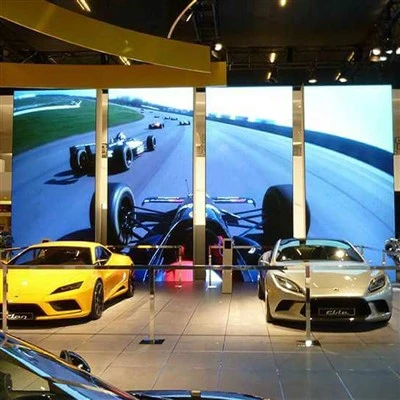
First, let’s clarify what a “poster LED screen” is, because sometimes people confuse it with large-format LED displays used for stadiums or outdoor billboards. Unlike those massive, high-brightness screens, poster LED screens are designed for indoor, close-proximity viewing—think of them as digital versions of traditional poster boards, with the brightness and flexibility to stand out in busy indoor spaces. That proximity is key; it’s why their maximum size isn’t just a matter of slapping more LED panels together. For reference, our standard poster screens use LED modules with pixel pitches ranging from 1.2mm to 3.9mm, which translates to the distance between each individual LED. Smaller pixel pitches mean sharper images for viewers standing closer, while larger pitches work for longer distances. This core design intent directly limits how big a poster LED screen can be before it loses its purpose as a “poster.”
Let’s start with the biggest constraint: human visual acuity. This is the science that underpins everything about display size and pixel density. The average human eye can distinguish individual LED pixels only if they are smaller than a certain angle, usually around 1 arcminute (1/60 of a degree). That means if a viewer is standing too far back from a screen, they won’t be able to tell the pixels apart, but if they’re too close, they’ll see a blocky, pixelated image—exactly what you don’t want for a poster, which is meant to look like a smooth, high-resolution graphic, not a grid of tiny lights.
To put that into numbers, let’s say we’re talking about a poster LED screen for a trade show, where most viewers will stand between 1 and 3 meters away. Using the 1 arcminute rule, the maximum size for a poster LED screen would depend on both the pixel pitch and viewing distance. For example, a 1.2mm pixel pitch screen (super sharp for close-up viewing) has a maximum viewing distance of about 2 meters. If you tried to make that screen bigger than, say, 2.5 meters wide, you’d have to step back more than 2 meters to avoid seeing pixels, which defeats the purpose of a poster—people don’t want to stand 10 feet away to read a promotion. For a 2.5mm pixel pitch, which is our most popular option for mid-sized spaces, the ideal viewing distance is 2.5 to 5 meters, so a maximum size of around 5 meters wide would be the sweet spot. Beyond that, and you start losing the “poster” feel; it becomes more like a small wall display, not a portable or wall-mounted poster that people can engage with at close range.
But wait—we’ve actually installed poster LED screens that go up to 8 meters wide for retail spaces, where the viewing distance is a bit farther, like 5 to 8 meters. How does that work? Well, when the intended audience is walking past a screen in a mall, they’re not standing right in front of it; they’re moving at a distance, so a slightly larger size with a larger pixel pitch (like 3.9mm) works. For those installations, the upper limit is still rooted in human vision, but shifted to accommodate a longer viewing distance. You wouldn’t call that a stadium screen, though—its dimensions are still too small for a stadium, and its pixel density is high enough for people to see details when they pause to look. That’s the sweet spot for commercial poster LED screens: between 2.5 meters (for close-up kiosks) and 8 meters (for storefronts or event entrances).
Next, there’s structural and practical limitations. LED screens are made of modular panels, so technically you could keep adding panels to make a screen as big as a wall. But a poster LED screen is supposed to be portable, easy to mount, and lightweight enough to hang on a standard wall frame or move between venues. A screen that’s over 8 meters wide starts to get heavy—each LED panel we use is about 50cm by 50cm, and each weighs around 2kg. So a 8-meter wide screen is 16 panels across, plus the frame, power supply, and processing hardware, which can add up to over 50kg. That’s manageable for a permanent wall installation, but not for a trade show that requires loading in and out in a day. We’ve found that for most clients, a 5 to 6 meter screen is the sweet spot: big enough to grab attention, light enough to install in a few hours, and fits through standard doorways (a 5-meter wide screen will fit through a 1.2-meter wide door if you take it apart into modules, but beyond that, you need custom installation which adds cost).
Another factor is content. Poster LED screens are used for specific content: product promotions, event schedules, art displays, wayfinding, or menu boards. If your content is a simple logo or a few lines of text, you might not need a screen larger than 4 meters wide. But if you’re displaying a high-resolution product image, a video ad, or a detailed infographic, the screen needs to be large enough to let viewers read text clearly. For example, a 10mm tall text at a 2-meter viewing distance needs a pixel pitch smaller than 1.2mm to be sharp. If you make the screen 8 meters wide with a 3.9mm pixel pitch, that same 10mm text would look tiny—too small to read from a distance of 5 meters. So even if the screen is technically big, it won’t serve its purpose if the content is unreadable.
We’ve had clients test the limits of these factors. A few years ago, a museum client asked for a 10-meter wide poster LED screen to display a historical map. At first, we tried to build it with 3.9mm pixel pitch, but when we tested it, visitors 3 meters away could see individual pixels, and the map details were blurry. We adjusted by adding a middle layer of 2.5mm pixel panels in the center, where viewing distance was shortest, and 3.9mm on the sides, but even that ended up being 7.5 meters wide. It worked, but it was a custom, non-standard installation—more of a hybrid wall display than a standard poster screen. Another client, a coffee chain, wanted menu boards for 10 locations, each 5 meters wide with a 2.5mm pixel pitch. That was easy to standardize, scalable, and fit their needs perfectly, with no compromise on readability.
It’s also worth noting that “maximum size” is not a one-size-fits-all number. If your space is outdoor? Wait, no—poster LED screens are designed for indoor, but if someone tries to use one in a semi-outdoor space like a covered patio, the maximum size might be slightly larger, since the ambient light is dimmer and viewing distance is a bit farther. But even then, we don’t recommend going over 8 meters, because the structural weight becomes too much for a patio overhang or awning.
So to wrap this up, the maximum size of a poster LED screen isn’t a fixed number like 5 meters or 8 meters—it’s a balance of four key factors: human visual acuity (pixel pitch vs. viewing distance), structural portability, content requirements, and space limitations. For most standard indoor applications, our go-to maximum is 8 meters wide, but that’s only when paired with the right pixel pitch and viewing distance. For portable or close-up use, it’s 2.5 to 5 meters. Any larger than that, and you’re moving out of the poster LED screen category into larger, more specialized display solutions.
If you’re planning an installation and want to find the right size for your space, content, and budget, we’re here to help. As a supplier, we work with clients every day to tailor screen sizes, pixel pitches, and mounting options to fit their specific needs—no generic advice, just hands-on guidance based on real-world projects. Whether you’re a small business looking for a menu board, a trade show organizer needing a portable display, or a retailer wanting a storefront upgrade, we can walk you through what will work best. Don’t hesitate to reach out to our team to discuss your requirements and get a custom recommendation for your project.
Indoor LED Screen References
- Barten, P. G. J. (1999). Contrast sensitivity of the human eye and its effects on image quality. SPIE Press.
- Society for Information Display (SID). (2021). Indoor display guidelines for commercial and public spaces. Journal of the Society for Information Display.
- National Association of Broadcasters (NAB). (2022). Trade show display design and spatial optimization guide.
Shenzhen ABXLED Industrial Co., Ltd.
Shenzhen ABXLED Industrial Co., Ltd. is one of the most professional poster led screen manufacturers and suppliers in China, featured by quality products and good price. Please rest assured to wholesale durable poster led screen in stock here and get quotation from our factory. We also accept customized orders.
Address: Building E, Diweixin Industrial Park, Beihuan Road, Shiyan, Baoan District, Shenzhen city, Guangdong Province, China
E-mail: Sales01@abxled.com
WebSite: https://www.abxled.com/
