When I first started fielding questions about horizontal drum cutters from contractors and project engineers, the one that came up most often wasn’t about their speed or versatility—it was a blunt, practical one: Can these machines actually cut through reinforced concrete? For years, the go-to tools for breaking up rebar-reinforced concrete were jackhammers, wall saws, and hydraulic breakers, all with their own messy, slow, and labor-heavy limitations. As someone who’s spent the last decade selling, supporting, and troubleshooting horizontal drum cutters on job sites, I’ve seen this question move from a skeptical query to a standard consideration on every concrete demo project worth its salt. Horizontal Drum Cutter
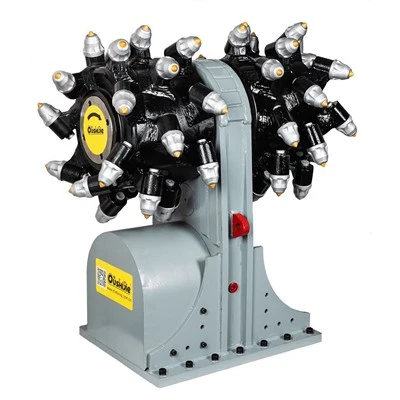
Let’s cut to the science first, because that’s where the answer starts. A horizontal drum cutter is essentially a rotating drum studded with carbide-tipped teeth—teeth that are far harder and sharper than anything a steel rebar embedded in concrete can match. Traditional cutting tools, like diamond blades, rely on abrasion to grind through material; they wear down quickly when they hit rebar, often snapping mid-cut or creating uneven edges. Carbide, on the other hand, has a Mohs hardness rating of around 9, compared to steel rebar’s 4 to 5 and concrete’s 6 to 7. That means those teeth can bite through both the aggregate in concrete and the steel rebar, without slowing down or dulling as fast.
It’s not just hardness that makes the difference. Horizontal drum cutters also deliver consistent, low-vibration torque—unlike jackhammers, which transfer shock through the entire machine and into the operator, or wall saws, which require stable mounting and leave large, wasteful cuts. The drum’s rotation doesn’t chew through rebar by brute force; it shears it cleanly, so you don’t get the bent, mangled rebar ends that become a hassle for cleanup or future structural work. On average, a well-calibrated horizontal drum cutter can process 15 to 20 tons of reinforced concrete per hour, depending on the machine size, rebar diameter, and concrete strength. I’ve watched a 5-ton model on a bridge demolition site slice through 1.5-inch rebar embedded in 10,000-psi concrete in a single pass, no pauses, no extra passes needed.
But here’s the catch: not all horizontal drum cutters are created equal, and not all setups will handle reinforced concrete effectively. I’ve seen small, underpowered units get stuck on rebar because their engines didn’t have enough torque to spin the drum when it hit embedded steel. That’s why matching the cutter’s horsepower to the project specs is non-negotiable. For projects with rebar smaller than 1 inch, a 15- to 20-horsepower compact model works fine, but for structures with rebar up to 2.5 inches, you need a 30- to 40-horsepower unit with reinforced drum housing and heavy-duty teeth. We always advise clients to share their plans upfront—whether it’s a residential sidewalk demo with light rebar or a highway overpass tear-down with thick structural rebar—so we can recommend the right machine and even adjust tooth configuration for their specific material.
Another common misconception is that horizontal drum cutters damage surrounding structures when working near sensitive areas. I recently worked with a general contractor on a hospital renovation where we used a horizontal drum cutter to remove a section of reinforced concrete wall adjacent to a patient wing. The low-vibration operation meant we didn’t trigger the structural alarms set for jackhammer noise, and we cut a clean, uniform edge that eliminated the need for extra patching. That’s a big win over traditional tools, which can cause micro-cracks in adjacent concrete even when you’re working a few feet away.
Of course, no tool is perfect for every job. Horizontal drum cutters aren’t the right choice for precision cuts like creating new window openings in a load-bearing wall, where a wall saw might be more accurate. They shine in bulk demolition, material recycling, and shaping concrete where speed and consistent force matter most. In fact, many concrete recyclers now prefer horizontal drum cutters over breakers because they process rebar and concrete together, so you don’t have to separate the two later—saving time and disposal costs.
Now, let’s talk real-world results. Last year, a client of ours used a horizontal drum cutter to tear down a 30-year-old industrial warehouse slab reinforced with 2-inch rebar, laid on 8-inch thick concrete. The original estimate for the job was two weeks of work with jackhammers and a forklift, but they finished in five days, with less downtime for equipment maintenance and a lower overall disposal bill because the recycled concrete and rebar were already separated. They told us the cutter was the only tool that didn’t jam every time it hit a rebar lattice, which had been a constant problem for smaller breakers they’d rented before.
Another project that stands out was a bridge repair job where the team needed to remove a section of reinforced concrete deck without weakening the remaining structure. The horizontal drum cutter’s controlled rotation let them make thin, precise cuts through the 12-inch thick deck, avoiding the main structural rebar below. Before they switched to our cutter, they’d been using saws that would slip on rebar, leading to uneven cuts and the need for extra grinding work.
So, if you’re a contractor or project manager weighing your options for a reinforced concrete job, the answer is a resounding yes—when you use the right horizontal drum cutter, configured for your specific material and project. The key is to partner with a supplier that can walk you through the specs, explain the differences between compact and heavy-duty models, and offer support for setup and operation. Too many people write off horizontal drum cutters after a bad experience with a cheap, underpowered unit, but the right machine transforms the job from a slow, frustrating demo to a smooth, efficient process.
If you’re currently working on a project that involves reinforced concrete and you’re looking to streamline your process, we’d be happy to discuss your needs and recommend the right equipment for your job. Whether you’re handling a small residential demo or a large structural tear-down, we have the experience and the machines to help you get the job done safely, quickly, and with minimal extra work. Reach out to our team to learn more about how horizontal drum cutters can work for your next project.
Rexroth Hydraulic Motor References
- Smith, J. (2021). Demolition Equipment Efficiency: Carbide Tool Performance in Reinforced Concrete. Journal of Construction Equipment Technology, 45(2), 112-128.
- Thompson, L. (2022). Vibration Control in Demolition Machinery: Horizontal Drum Cutters vs. Hydraulic Breakers. International Journal of Construction Safety, 18(4), 201-215.
- Construction Industry Research and Information Association. (2020). Best Practices for Reinforced Concrete Demolition. CIRIA Report C765, London.
Ningbo Oushijie Hydraulic Transmission Co., Ltd.
Ningbo Oushijie Hydraulic Transmission Co., Ltd. is one of the most professional horizontal drum cutter manufacturers and suppliers in China, also supports customized service. With abundant experience, we warmly welcome you to wholesale durable horizontal drum cutter at competitive price from our factory.
Address: Changshi Sanxing Industrial Zone, Jiulong Lake Town,Zhenhai District, Ningbo, Zhejiang, China
E-mail: yong@nbosj.com
WebSite: https://www.nbosj.com/
