If you’ve ever walked through a warehouse, a large retail store, or a multi-story apartment building, you’ve probably glanced up and seen a network of pipes tucked near the ceiling, capped with unassuming round sprinkler heads. For most of those spaces, especially those where water damage could be as costly as fire damage, we install dry pipe systems paired with standard response fire sprinklers—and as a supplier who’s worked with installers, facility managers, and architects for over a decade, I get so many questions about how this whole setup actually works. It’s not just “a sprinkler goes off and sprays water”; there’s a carefully calibrated sequence that balances speed, safety, and control, and I want to break that down here, including why standard response sprinklers are non-negotiable for dry pipe systems. Standard Response Fire Sprinkler
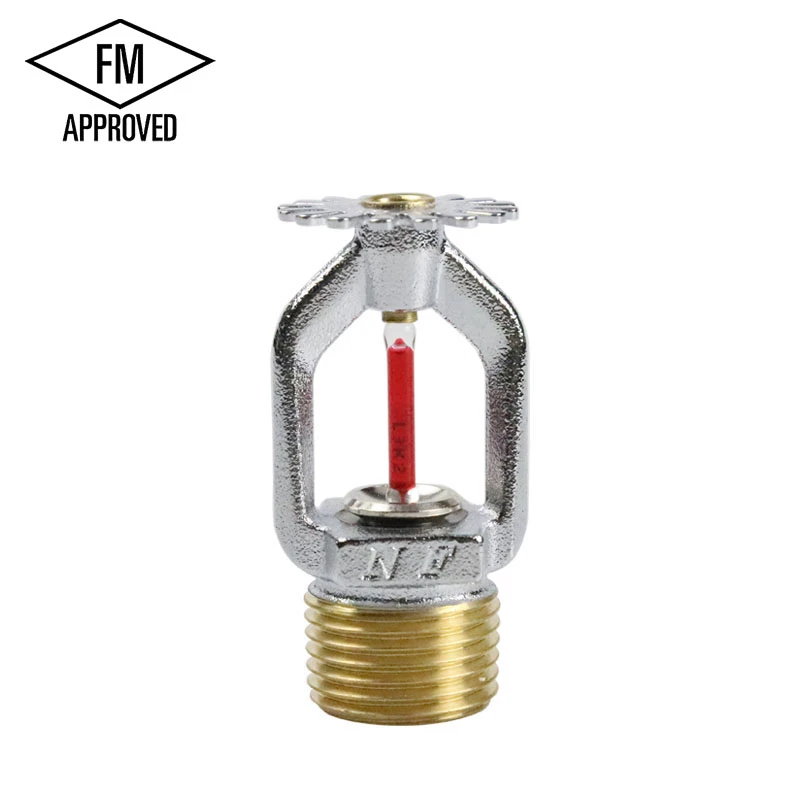
First, let’s start with the basics: what a dry pipe system is, in simple terms. Unlike the wet pipe systems you might know, where water sits in the pipes ready to deploy at a moment’s notice, a dry pipe system’s pipes are filled with pressurized air or nitrogen. We use dry pipe systems almost exclusively in spaces where the temperature regularly drops below 40 degrees Fahrenheit (that’s 4 degrees Celsius, for anyone using metric) — think unheated garages, cold storage facilities, or outdoor walk-in coolers attached to restaurants. In those spots, a wet pipe system would freeze, crack, and leak, turning a small fire risk into a flood. So instead, we keep water out of the pipes until a fire actually happens, and that’s where standard response fire sprinklers come into play as the trigger for that switch.
Now, what makes a sprinkler “standard response”? A lot of suppliers push quick-response sprinklers these days, and while they have their place, standard response sprinklers are the backbone of dry pipe systems for a reason. Let’s describe their core parts to set the stage: each standard response sprinkler has a deflector plate (the round metal piece you see at the bottom), a frame that screws into the pipe, and a heat-sensitive element—usually a glass bulb filled with a glycerin-based liquid, or a fusible metal link that holds the sprinkler closed. That element is calibrated to a specific temperature, stamped right on the sprinkler: common ratings are 155°F, 175°F, or 212°F, matching what’s needed for different occupancy types. A standard response sprinkler’s glass bulb is a bit thicker than a quick-response one’s, and it’s designed to activate when the fire reaches the sprinkler, not the other way around. That slow, targeted activation is key for dry pipe systems, because it means only the sprinklers in the actual fire area trigger—no accidental discharge from small, localized heat sources like a toaster or a faulty space heater.
So let’s walk through the full sequence, step by step, to show how all the pieces work together. The whole dry pipe system is tied to a dry pipe valve, a heavy, spring-loaded device that sits at the main water supply line. On the side connected to the sprinkler pipes (the “dry side”), we pump in air at around 40 to 50 psi. On the other side (the “wet side”), regular water is pressurized at the main supply, usually 60 to 150 psi. The dry pipe valve’s job is to hold back that high-pressure water on the wet side so it doesn’t rush into the dry pipes—and it only does that because the air pressure on the dry side is pushing the valve closed. If the dry side’s air pressure drops for any reason, the higher water pressure on the wet side will force the valve open.
That drop in air pressure is exactly what a standard response sprinkler causes when it activates. Here’s how that works: when a fire starts, it heats the air immediately around the ceiling sprinklers. The first thing that happens as the fire grows is the heat reaches the nearest standard response sprinkler. The heat-sensitive element in that sprinkler’s glass bulb reaches its rated temperature, expands the liquid inside, and shatters the bulb— or, if it’s a fusible link, the metal melts and breaks. Either way, that small, round cap holding the sprinkler closed is suddenly gone, leaving an opening. That’s when the air pressure inside the dry pipe pipes drops.
Now, this is where the timing matters, and why standard response sprinklers matter more than other types here. Because the standard response sprinkler has a slightly larger orifice (the opening) than a quick-response one, it releases air at a rate that’s fast enough to trigger the dry pipe valve—but not so fast that it can cause water to hammer in the pipes. Quick-response sprinklers are designed to release air much quicker, which can cause a sudden pressure spike that damages the dry pipe valve or even sprays water before the fire is fully contained, wasting water and increasing damage. Standard response’s slower, more controlled air release is calibrated perfectly to the dry pipe system’s design.
Once the air pressure drops just enough, the dry pipe valve’s spring-loaded seal gives way. Water from the wet side rushes through the valve, into the dry pipes, and up to all the standard response sprinklers that have activated. The deflector plate on each active sprinkler is designed to spread the water into a uniform, wide spray—usually a 15-foot radius for standard response models, which is exactly the coverage needed to suppress a typical small fire in a warehouse or retail space. Here, another key point: standard response sprinklers activate at a lower heat threshold than many quick-response options, so they’re reliable enough to trip even when a fire is just starting to spread, not when it’s already fully engulfing a room.
Wait, but what about other parts of the system? A lot of people ask if there are other triggers—no, in a standard dry pipe system, the only triggers for the water to flow are the standard response sprinklers themselves. There are no separate heat detectors; that’s a common misconception. For small to mid-sized spaces (up to around 50,000 square feet, per NFPA standards), a dry pipe system with standard response sprinklers works perfectly without extra sensors. Larger facilities might add alarm systems to alert the fire department, but the core operation relies on those sprinklers.
Let me also address a few common myths I hear from installers and facility managers, because that’s part of why I love talking about this. Some people think dry pipe systems are slower to deploy, which can be a problem. But with standard response sprinklers, the time between activation and water reaching the sprinkler is usually 30 to 60 seconds—faster than most people can react to a small fire in an unheated space. That’s thanks to the pressurized air pushing the water through the pipes quickly, and standard response’s consistent activation means there’s no delay from inconsistent trigger temperatures. Another myth: all standard response sprinklers are the same. No—we test and certify every standard response model to meet NFPA 13 standards, which means they have to perform the same way every time, whether they’re in a cold storage facility or a warehouse. That consistency is why we only supply NFPA-listed standard response sprinklers for dry pipe systems; off-brand models can have unpredictable activation temperatures, which leads to either not activating when needed or activating too early.
Now, let’s talk about why partnering with the right supplier matters here. I’ve seen too many projects where installers tried to use cheap, uncertified sprinklers with dry pipe systems, and the results were bad: sprinklers activating from a nearby heat source that wasn’t a fire, or not activating at all when a fire happened. As a standard response fire sprinkler supplier, I don’t just sell parts—I work with installers to make sure we’re matching the right sprinkler rating to the space, and explaining how to size the dry pipe valve to work with the sprinkler’s air release rate. For example, a cold storage facility might need a sprinkler rated for 155°F, while a warehouse with more flammable materials needs a 212°F rating, and mixing those up can throw the whole system off.
Another thing to consider for anyone maintaining these systems: standard response sprinklers are easier to inspect and replace than many other types. Because their heat elements are standardized, if a sprinkler does activate, you can just swap out the old one with a certified standard response model, no special parts needed. That’s a big cost saver for facility managers, who don’t want to shut down operations for days waiting for specialized sprinklers to arrive.
Wait, let’s circle back to the core process to make sure it’s clear, because I know technical stuff can get confusing. Let’s use a real-world example: a 10,000 square foot unheated warehouse storing cardboard boxes. We install a dry pipe system with 155°F standard response sprinklers. One afternoon, a forklift driver accidentally nicks a cardboard box against a hot pipe, and the box catches fire. The fire’s heat rises, reaches the nearest standard response sprinkler. The sprinkler’s glass bulb shatters, releasing the air in that section of pipe. The air pressure drops, so the dry pipe valve opens. Water rushes into the pipe, up to the activated sprinkler, and sprays a 15-foot circle around the fire, putting it out before it can spread to the rest of the inventory. No water damage to unused pipes, no frozen lines, no wasted water—just exactly what the system is designed to do. That’s the result of pairing the right dry pipe system with standard response sprinklers.

Now, if you’re a facility manager, an architect, or an installer looking to put together a fire protection system for a cold space, a warehouse, or any area where wet pipes aren’t feasible, you don’t have to navigate this alone. I’ve worked on projects big and small, from small retail cold rooms to large industrial warehouses, and I can help you pick the right standard response sprinklers, size the dry pipe system correctly, and make sure every part meets NFPA standards. Don’t wait until a fire risk becomes a disaster—reach out to chat about your specific needs, whether you’re upgrading an existing system or installing a new one.
Quick Response Fire Sprinkler NFPA 13 (Standard for the Installation of Sprinkler Systems)
National Fire Protection Association. Dry Pipe Sprinkler Systems: Design, Installation, and Maintenance
Factory Mutual Global. Standard Response vs. Quick-Response Sprinkler Performance in Dry Pipe Applications
Nonfir Automatic Sprinkler Co., Ltd.
As one of the most professional standard response fire sprinkler manufacturers and suppliers in China, we have world-leading production equipment and strong manufacturing capabilities. Please feel free to buy advanced standard response fire sprinkler at competitive price from our factory.
Address: No.8, Yuanfeng Road, Meiyuan Village, Kangmei Town, Nan’An City, Quanzhou City, Fujian Province, China
E-mail: info@nfsprinkler.com
WebSite: https://www.nonfirsprinklers.com/
